The Family
|
||||||||||||||||||||||||
|
||||||
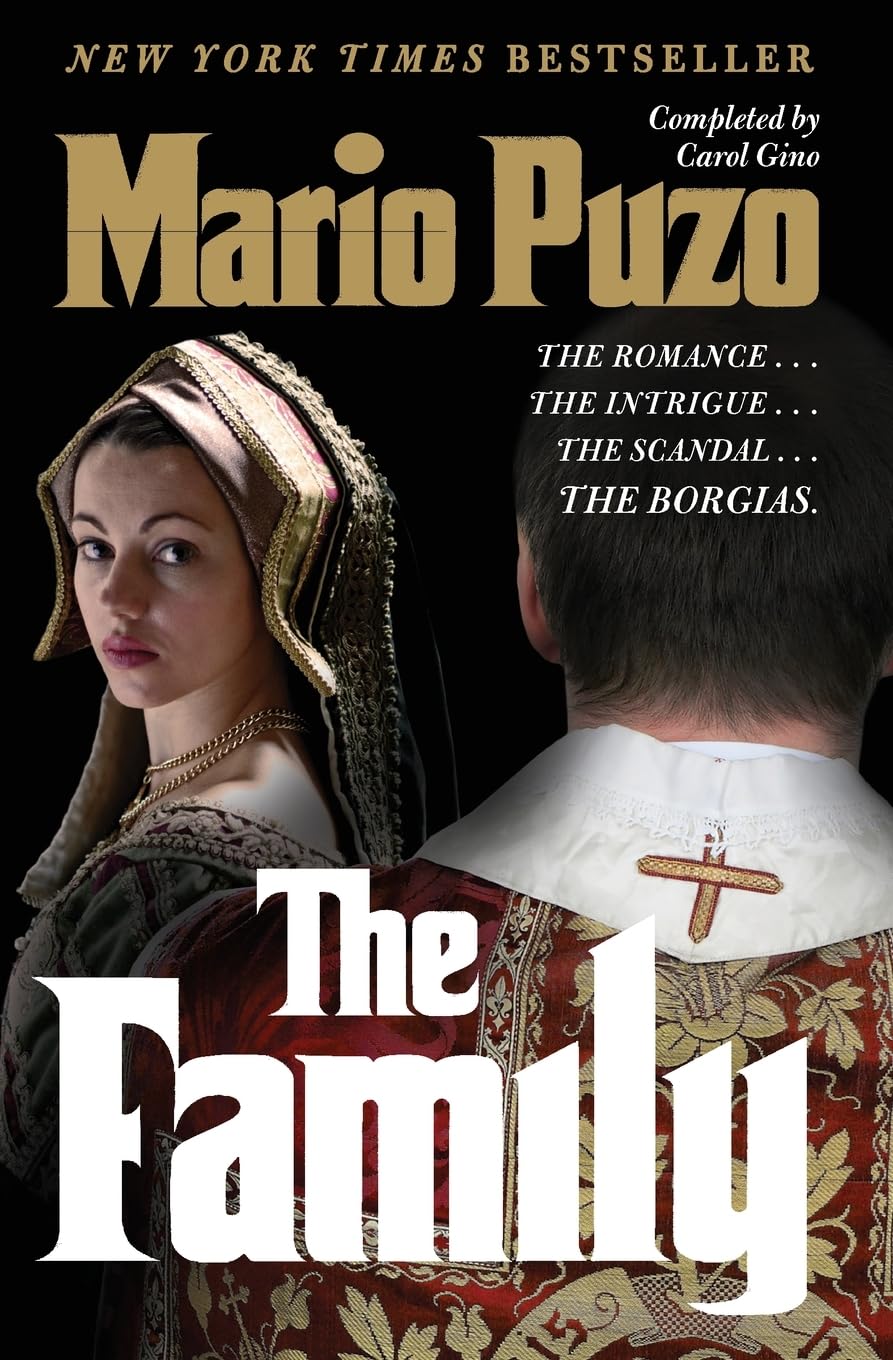
Mario Puzo’s final masterwork. A sweeping epic saga of corruption, greed, treachery, and sin, The Family is the ultimate crowning achievement of the #1 New York Times bestselling novelist who gave the world The Godfather, arguably the greatest Mafia crime novel ever written. In The Family, Puzo—whom the Washington Post calls, “A serious American talent”—plunges reader into the colorful tumult of the Italian Renaissance, immersing them in the roiling intrigues and deadly affairs of the remarkable family whose name has always been synonymous with power, corruption, poison, and murder: the infamous Borgias.
Endorsements
|
“Dazzling, passionate, a masterwork that ranks with Puzo’s best.” |
|
“One of his most satisfying works….A thoroughly entertaining posthumous present from one of the masters of popular fiction.” |
|
Before his death in 1999, Puzo (The Last Don) had begun work on a novel featuring the 15th-century Borgias, whom he regarded as “the original crime family.” There are obvious parallels between the Borgias and the Corleone clan immortalized in The Godfather, but the resemblances are mostly superficial, at least as they are presented in this limp historical romance. The story opens with Cardinal Rodrigo Borgia manipulating papal elections in 1492 to become the new Pope Alexander. Determined to establish a family dynasty, he appoints his son Cesare cardinal in his stead and, after a strategically engineered episode of incest between siblings Cesare and Lucrezia, begins ruthlessly eliminating rivals and marrying his children into alliances with the offspring of noble families of France and Spain. But Cesare would rather be a soldier, and Lucrezia would rather marry for love; these conflicted desires contribute as much as risky political power plays to undoing the Borgias in a single generation. Though Gino (Puzo’s companion, author of Then an Angel Came) is credited for the posthumous completion, Puzo’s true collaborator is history, and it proves a difficult partner. Obligated not to deviate from known facts, the narrative whizzes methodically through highlights of the Renaissance, embellishing events with snatches of imagined dialogue, purple prose (“For love can steal free will using no weapons but itself”) and cameos by Machiavelli, Michelangelo and da Vinci. Overwhelmed by the vast pageant of events, the characters never achieve dramatic stature. Puzo’s diehard fans will surely put the novel on their summer hit list, but they may feel, in Sonny Corleone’s words, that “this isn’t personal,it’s business.” —Publishers Weekly |
About the Authors:
Mario Puzo was born in New York and, following military service in World War II, attended New York’s New School for Social Research and Columbia University. His bestselling novel The Godfather, (1969) was preceded by two critically acclaimed novels, The Dark Arena (1955) and The Fortunate Pilgrim (1965). In 1978, he published Fools Die, followed by The Sicilian (1984), The Fourth K (1990), and the second installment in his Mafia trilogy, The Last Don (1996), which became an international bestseller and the highest-rated TV miniseries of 1997. Author biography courtesy of Random House, Inc.
Carol Gino is a registered nurse with a MA in Transpersonal Psychology whose twenty-year career has included experience in almost every area of health care, from critical care nursing to hospice to teaching.
The Nurse’s Story was her first book, and her articles have appeared in New York magazine, Nursing, American Journal of Nursing, and The Chicago Tribune. She has done several cross-country media tours advocating patient rights and to change the Image of Nursing.
Several book clubs chose the Nurse’s Story and it was published in 9 foreign countries.
Her books are:
The Nurse’s Story – New York Times bestseller
Rusty’s Story – New York Times bestseller
Then An Angel Came – Award Winner
There’s An Angel In My Computer – New!
Carol Gino spent 20 years in relationship with Mario Puzo, author of “The Godfather”. After his death in 1999, she completed his manuscript of “The Family,” which was also a best seller.
|
||||||
THE FAMILY brings the lawless world of 15th-century Rome to vivid life, revealing the secrets of the Vatican just as Mario Puzo once laid bare the mysteries of the Mafia. This extraordinary epic revolves around Rodrigo Borgia, Pope Alexander VI, a larger than life hero propelled by a myriad of passions-power, faith, luxury, women, and an all-powerful love of family. While his blessings are sought by kings and peasants alike, enemies from within and abroad plot his demise. As Alexander strives to restore glory to the Catholic Church and unify the city-states of Italy, he also seeks to direct the lives of his beloved children. But for all Alexander’s love and might, he cannot reverse the legacy of sin that is revisited upon his children.
Alexander’s son, the passionate Cesare, is torn between his father’s wish that he serve the Church, and his own desire to be a warrior. The story of Cesare’s rise and fall is a cautionary tale of obsession and arrogance, a story at once mythic and viscerally suspenseful. He and his sister, Alexander’s beautiful and sensitive daughter Lucrezia, are jointly cursed by an unthinkable secret, served unto them by their father. And the violent fate of Alexander’s heartless son Juan is eventually echoed by the deadly vengeance of the Pope’s neglected son Jofre. Torn between familial love and their own irresistible motivations, the Borgias are by turns each other’s most steadfast saviors-and each other’s greatest threat.
At the time of his death in 1999, though he had reached the end of the story-including writing the epilogue-Puzo had left several chapters unfinished. Working directly from his detailed notes and outline, his longtime companion, novelist Carol Gino, completed the work soon thereafter. “Mario was fascinated with Renaissance Italy, and especially with the Borgia family,” Gino writes in her Afterword to the book. “He swore that they were the original crime family, and that their adventures were much more treacherous than any of the stories he told about the Mafia. He believed the Popes were the first Dons-Pope Alexander the greatest Don of all.”
An unforgettable saga of grand scope and dark intrigue, THE FAMILY is the crowning achievement of one of the most gifted storytellers of our time.
|
||||||

This is the story of the greatest power family in Italian history–the Borgias. Set in fifteenth-century Rome, this is a labor of love more than a decade in the making.